
The NHL Loves Improv
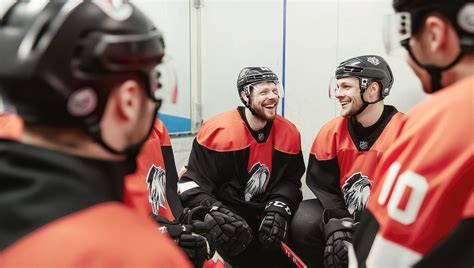
When I was a junior in college I dated a hockey player. That’s not true. He was a recovering hockey player who lived in what was known as the “hockey frat.” For half a semester I spent some time in their house. The smell of beer and the Boston accents weren’t the only things that hung in the air. There was the machismo of it all. Suffice it to say, no one was excusing themselves to run out to their therapy appointment. Or their Improv class.
The times they are a changin’!
This week the NY Times, the paper of record, reported the use of Improv as highly effective training for The National Hockey League.
No joke, the article highlights how players and coaches are turning to improvisation training, not to be funnier, but to become better teammates. Through workshops led by experienced instructors, athletes are learning unconventional skills. These abilities have little to do with slamming a puck into a net while wearing ice skates and everything to do with communication, trust, adaptability, and leadership. They're even being used to build confidence in their public speaking and when talking to reporters!
Can you say validation? We can! Not to be snarky, but running a company that has been preaching the religion of Improv for creating trust and team-building, getting endorsement from a literal sports team is, to say the least, very cool!
Add to this that professional hockey is probably one of the last places I’d expect to find Improv exercises. The others being a dictatorship and a memory care home.
And yet, these elite athletes who play one of the fastest, most physical, “get the f out of my way,” sports are discovering the value of Improv principles like building on each other’s ideas, active listening and making your partner look good.
Full disclosure as a recovering stand-up comedian, that last one was probably the final frontier for me in adapting my comedy skills.
The “yes, and” principle of Improv is so ubiquitous at this point, even writing about it here feels cliché. And yet the NY Times jumps all over it! They make clear, as me and my team have said probably thousands of times now, responding with the words “yes and,” in conversation does not necessarily mean I agree with you. It is, however, the most concise way to keep people talking and learning more about what matters to each other.
The other outcome of using Improv principles to guide your communication on and off the ice is that it builds trust. Having watched world cup soccer recently and the basketball play offs before that, I do find it amazing how much trust, how much interdependence is needed for these teams to succeed. Especially with a ball or puck flying at breakneck speed.
Despite what many people think, The strongest improvisers aren't the funniest people on stage.
They're the people who notice what their partner needs. They listen deeply. They ask questions and stay curious.
They recover gracefully when things don't go according to plan. Which is exactly what high-performing teams on and off the ice need to do.
One of my favorite quotes from this article, that is very similar to feedback Laughter On Call has heard from the many all hands kick-offs we’ve run, is from Jamey Horan, VP for communications for the NHL.
“These guys have never met before. After this, there’s a level of respect when they meet on the ice.”
True, our clients like Meta, Amazon, and the healthcare teams we’ve trained around the world will never meet on the ice, but they do meet in conference rooms, hospitals and senior communities. The latter moves at quite a different pace! Yet the stakes for clear communication and trust are just as high, if not higher. Basic improv training delivers these skills. Even for those who are least likely to buy in.
I have vivid memories now of what is reported in the article. Walking into a room of people with folded arms and mumbled responses initially, who by the end of our workshops are flapping their arms like eagles or proudly reciting their own “declaration of independence,” creating gales of laughter no one would have thought possible when they walked in.
There’s that word again. Laughter. It may not be the only goal in this kind of training, but what a gift when it happens. Because there’s nothing like shared laughter for jump cutting to all of the other goals of trust, team-building, and setting a foundation where innovation can flourish.
Ultimately what more and more people are learning and maybe this is a result of our AI saturated future, is that concurrently with that growth, is the need to cushion ourselves, our humanity if you will, from the blows of these tech advancements.
And nothing reminds us more of this than sharing laughter with another human. Although I did get a “ha!” out of Chat last week. Claude not so much.
So yes I smiled reading this article. If macho hockey guys and their leaders believe that Improv training encouraging active listening, adaptability, exposing some vulnerability, and fostering collaboration make them stronger competitors, there is hope! Maybe in the near future I can cut down my opening half dozen slides of “impact” data for what laughter can bring to your people. Instead, we can spend more time engaging and interacting with each other, experiencing one of the most effective tools we have for creating connection, belonging and trust. Hashtag goals.
Ready to get your dose of laughter?
Discover how Laughter On Call can bring more connection to your team, family, or caregivers.
Read More Stories